Zootennis


Schedule a training visit to the prestigious Junior Tennis Champions Center in College Park, MD by clicking on the banner above

Friday, September 9, 2005

One, Two, Three--Boys Seeds Disappear; Glatch only U.S. Player Left in Singles
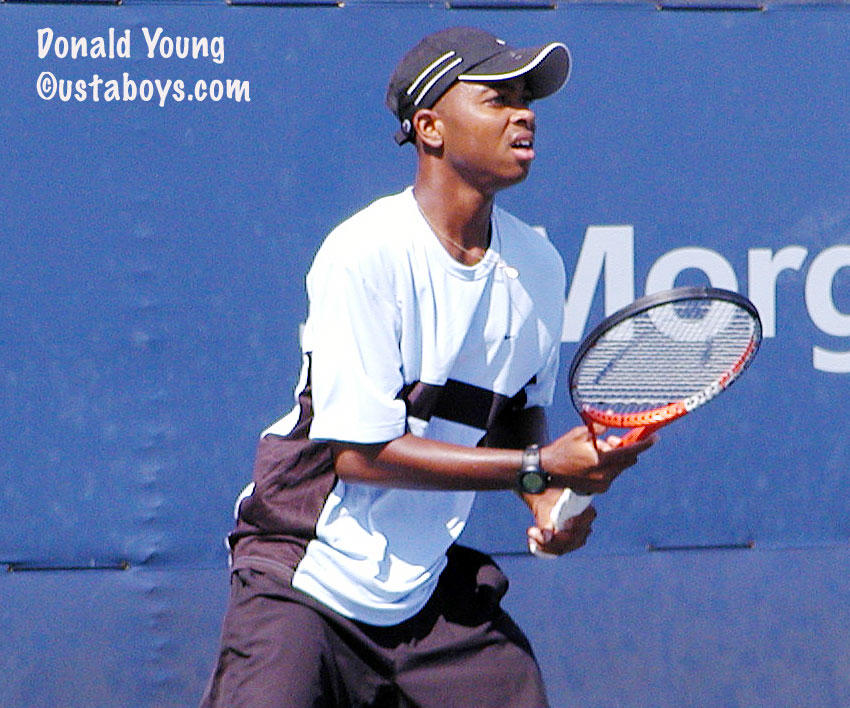


One, Two, Three--Boys Seeds Disappear;Glatch only U.S. Player Left in Singles--
©Colette Lewis
Flushing Meadow NY--

It was the same-old same-old today; perfect weather and Donald Young losing the first set.

The weather continued its streak, but Young’s flair for winning went the way of the scattered morning clouds, and he fell to sixth seed Sun-Yong Kim 7-6 (1), 2-6, 7-6(2).

Young served for the match after breaking Kim when the Korean was serving at 5-5 in the third. “He played great during that game,” said Kim through his interpreter and coach Jung Hoon Park. “He deserves the credit.”

But the eighteen-year-old Korean showed no inclination to surrender and at 6-5, 30-40 got new life when Young hit a forehand into the net.

And unfortunately for the top seed, that was only the first of many to come in the tiebreak. The first three points, all won by Kim, were forehand errors, and the sixteen-year-old from Chicago misplaced his knack for elevating his game. Kim, from outside Seoul, can hit the ball hard and flat, but his strategy was obviously to deny Young pace, as there was a lot of girls 14s in their rallies. Kim had lost to Young in straight sets in the Australian final, but observers of that match said the swirling winds and the nerves of both players didn’t provide the best conditions to test their tennis skills.

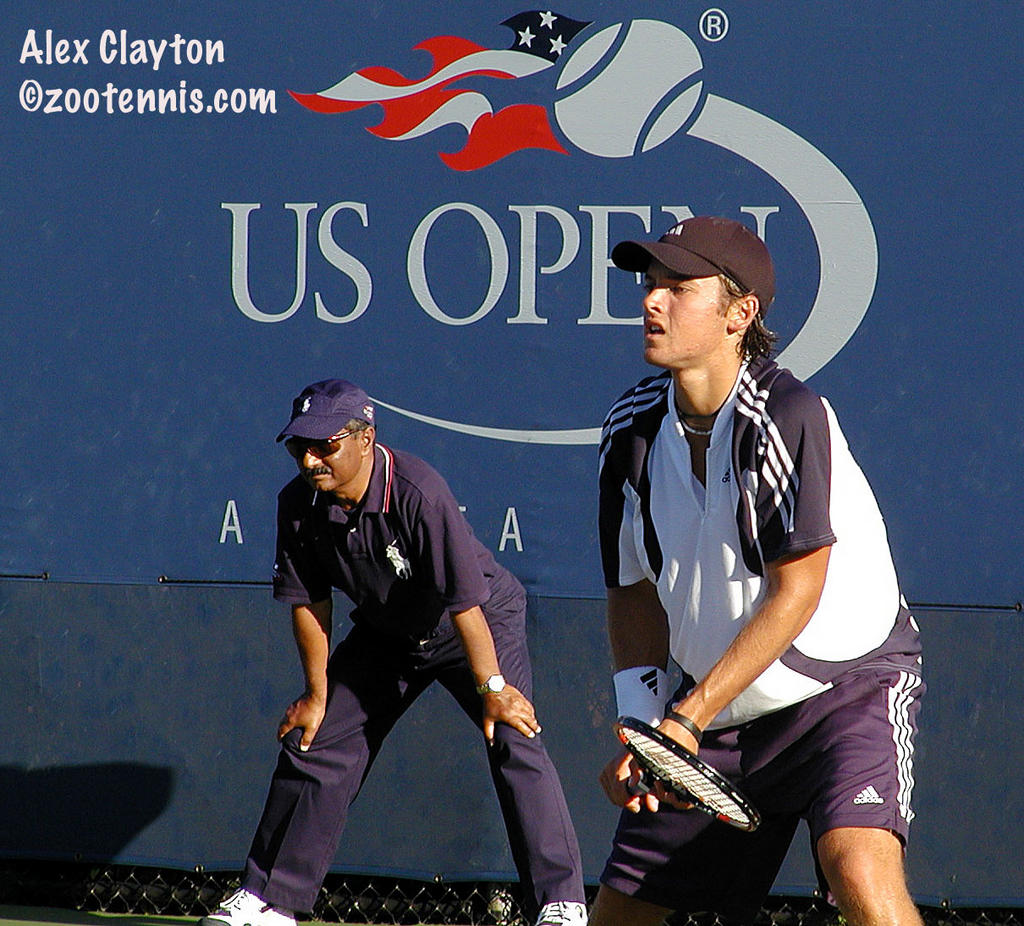
The weather couldn’t be blamed on Friday, but maybe the load of four straight three set singles matches on top of doubles could. But some of the pain of singles loss was allieviated when Young and partner Alex Clayton earned a spot in the doubles final by defeating the third seeded team of Petar Jelenic and Evgeniy Kirillov 6-2, 6-3. Clayton and Young, seeded eighth will meet Carsten Ball and Thiemo de Bakker, the second seeds, who took out Wimbledon champions Jesse Levine and Michael Shabaz 6-1, 6-3.

Alexa Glatch, the only American remaining in junior singles, will also be playing for a Grand Slam title on Saturday. Glatch, a straight-set winner over third seed Dominika Cibulkova of Slovakia in singles, and partner Vania King dispatched the fifth seeded team of Wen-Hsin Hsu and Amina Rakhim in straight sets. Glatch and King, the second seeds, will face Nikola Frankova and Alisa Kleybanova, the seventh seeds.

“Vania and I have a great time out there,” said the six-foot righthander from California. “I love to play doubles now. I was never a great doubles player before I started playing with Vania. She’s taught me a lot.”


One thing everyone learned today at the National Tennis Center is beware the underdog. In addition to top seed Young, the boys draw lost second seed and French Jr. Open champion Marin Cilic, a loser to Wimbledon Jr. Champion Jeremy Chardy and third seed Leonardo Mayer, defeated by unseeded Ryan Sweeting.

“It was surreal out there,” said the eighteen-year-old Bahamian, who took out the powerful Argentine 6-4, 7-5, winning the last four games played. “I don’t remember a single point from the match. Even match point, I think I thought I hit a serve winner, I raised my arms in the air and then it came back and somehow I hit an overhead to win it.”

It wasn’t just the seeding that made the result surprising—in the recently concluded ITF Grade 1 in Canada, Mayer had defeated Sweeting 6-4, 6-1 in the semifinals.

Frenchman Chardy was seeking revenge, as the towering Croatian had eliminated him in the second round of the Australian Open this year, but after Chardy, the seventh seed, dropped the first set 6-4, it seemed unlikely that he’d get it. But he drew confidence from his play in the Canadian, even though he lost in the quarterfinals.

“I felt I was playing well on hard courts there and in the first three rounds here,” said Chardy, who spoke through an interpreter.

The points were short in the match and the play alternately brilliant and lackluster. It was difficult for either player to get a rhythm, as rallies were rare, but Chardy finally began to use his professional-grade serve to advantage and Cilic did not.

The highest seed remaining in the boys draw is Santiago Giraldo of Columbia, who was tabbed for the fourth spot based on his ATP ranking (currently 399). Giraldo’s penetrating groundstrokes have given all of his junior opponents fits, and unseeded Tim Smyczek was no exception. The first set, which Giraldo won 6-1, seemed to be over in about fifteen minutes. But Smyczek recovered to win the second set 6-3, and Giraldo appeared agitated to have dropped his first set of the tournament. But with his small group of vocal supporters evident on winners and errors alike, Giraldo took an early lead in the third set and never looked back, taking it 6-2.
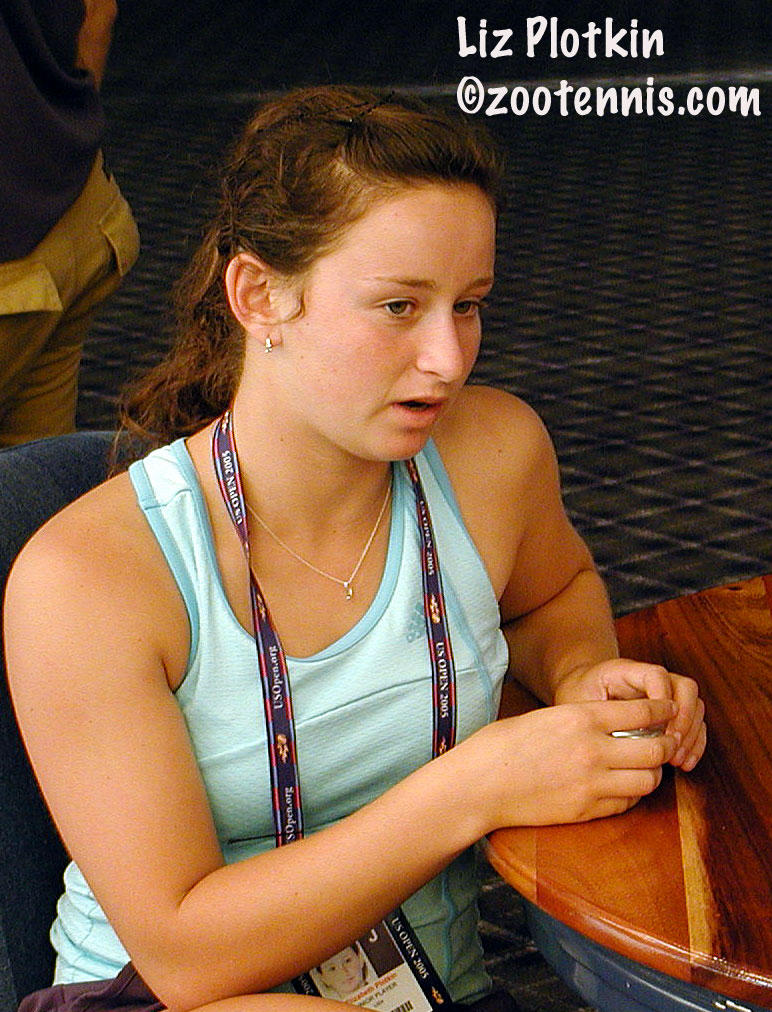
Unseeded Liz Plotkin of San Francisco was hoping to join Glatch in an All-California semifinal and was ahead in both sets, 5-3, and 3-1 in her match with unseeded Nina Henkel of Germany Friday afternoon, but she dropped both by identical 7-5 scores.

“It was a winnable match,” said Plotkin. “But I wasn’t on the court today. Definitely not on this planet. But credit to my opponent—she played well.”

Mihaela Buzarnescu of Romania and Victoria Azarenka of Belarus meet in the other semifinal. Buzarnescu, seeded 14th, fought off a determined challenge by qualifier Olga Govortsova, 6-2, 7-6 (3) and will face a very well rested Azarenka. The top seed has lost only eight games in four matches, and today she played only seven games total when doubles partner Marina Erakovic retired 5-2. Erakovic had suffered a back injury in her victory Thursday over Vania King and was unable to play doubles later in the afternoon. The unfortunate injury to Erakovic dashed Azarenka’s hope of winning all four Grand Slam doubles titles in 2005.

For complete draws, including doubles action, see usopen.org

For more photos see ustaboys.com

Thursday, September 8, 2005

Tennis Beauty in The Eye of this Beholder


--
Tennis Beauty in The Eye of this Beholder
©Colette Lewis 2005
Flushing Meadows NY--

The buzz around the sun-splashed National Tennis Center on Thursday, even among junior aficionados, was the Agassi-Blake epic Wednesday night, or rather, Thursday morning. Tennis WAS the winner, as Agassi said, but not many juniors with 11 a.m. matches would have stayed up late enough to be inspired by it.

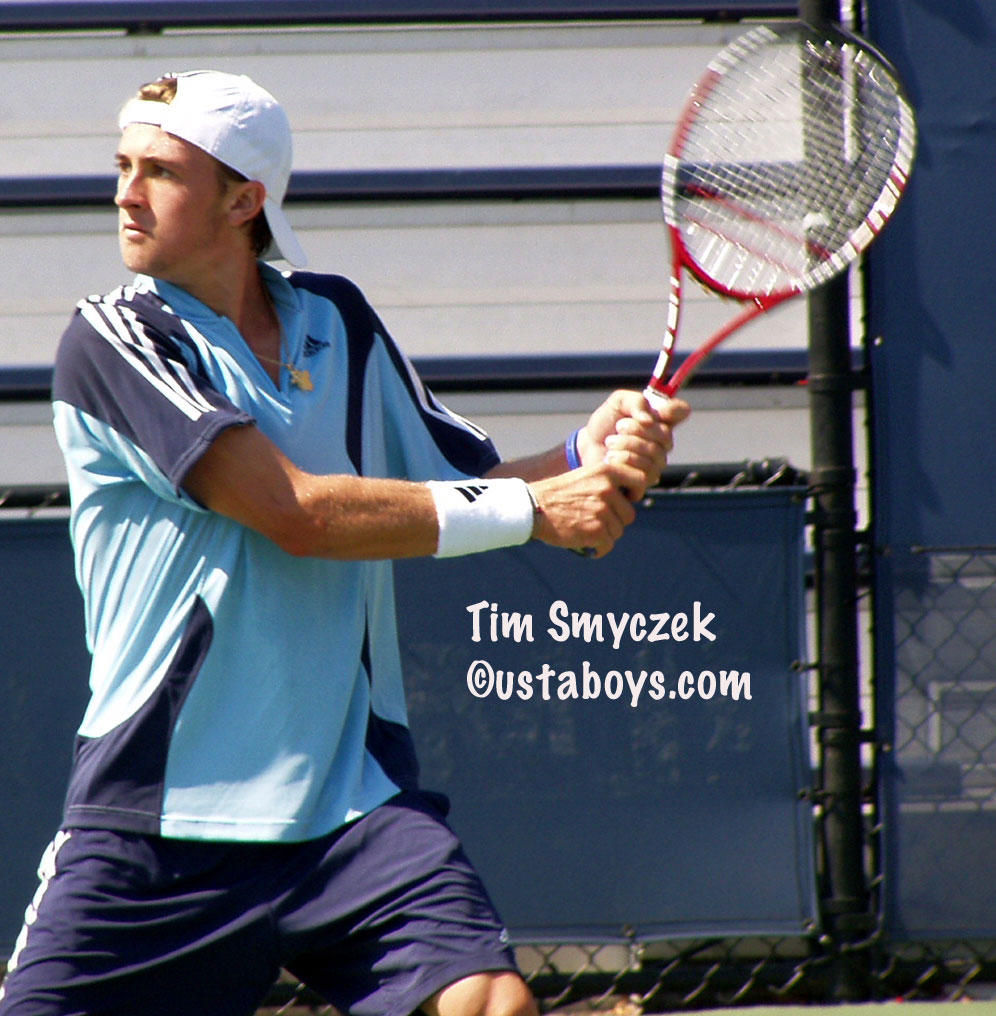
I had intended to check in on all the first-on junior matches, so I caught a few games at this court and that, then moved on, until I reached the Kuznetsov-Smyczek contest. The quality of tennis was so high, I took a seat and never left. In the first set, I was gasping every third point.

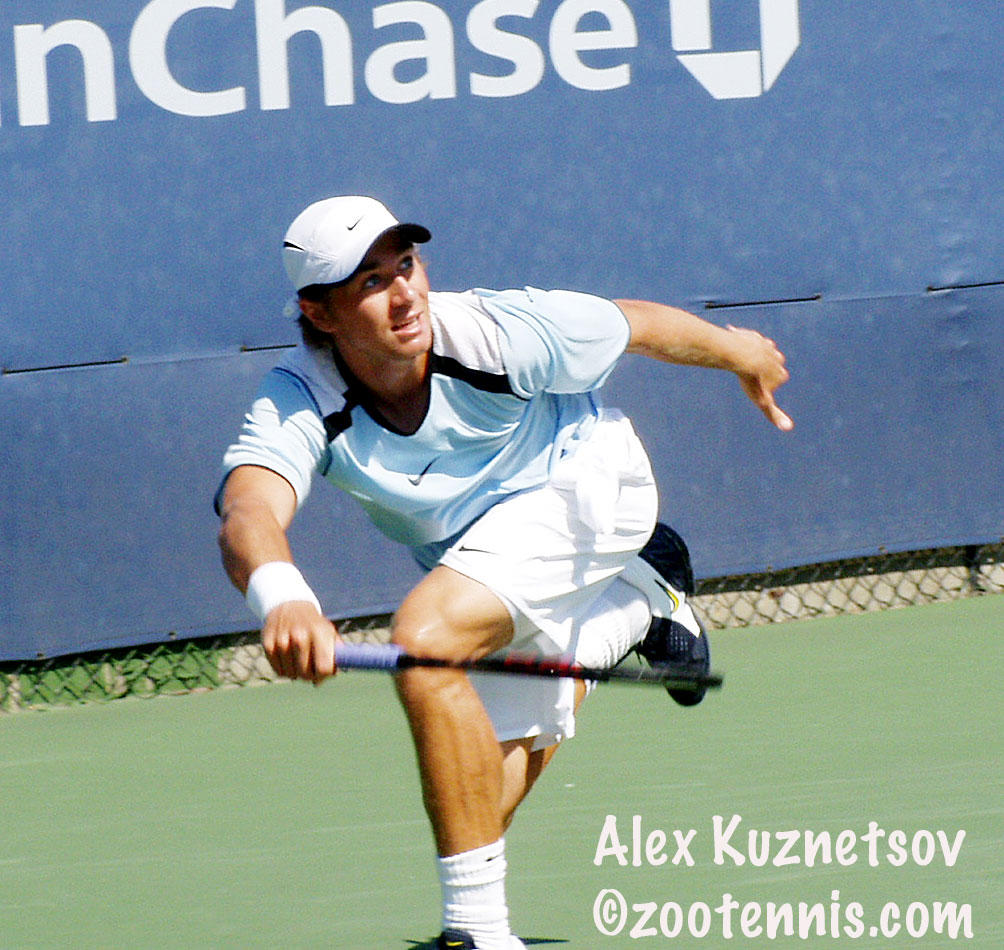
Kuznetsov was seeded fifth, based exclusively on his ATP ranking, as he had not played a junior ITF event since last year’s Open. Judging from the way he moved and struck the ball in the first set, his recovery from the broken leg he suffered in a car accident in May is nearly complete. The unseeded Smyczek, a junior Wimbledon semifinalist, matched him shot for shot. Those who disparage junior tennis should be required to watch a (sadly nonexistent) video of that first set, won by Smyczek 7-6 (3). A single viewing and they’d see that the beauty of the game is not confined to the top level.

Smyczek, who moved quickly to every ball and hit it smack in the center of the racquet, was the first to blink, losing his serve at 4-4, when he missed an easy putaway at the net. But it didn’t faze him, and he never gave Kuznetsov a sniff at a set point. Smyczek’s lunging crosscourt touch volley at 15-40, was Federer-like, so high was its place on the Wow scale.

The ensuing tiebreak belonged to Smyczek, where even Kuznetsov’s best serve rarely won him a point. Kuznetsov also went to the drop shot early and often and although it won him several key points in the first set, when he really needed it in the second it had lost that essential element of surprise critical with a player as speedy as Smyczek.

“I think that was a result of his lack of match play,” said the seventeen-year-old Wisconsin native. “We train a lot together at Saddlebrook, and I know he’s not 100%. I had to make believe it wasn’t Alex across the net.”


The second set was decidedly less scintillating.

“I have my highs and lows,” Smyczek admitted. “The tiebreak was my high and the start of the first set was my low.” Broken the first time he served, Smyczek again broke back immediately--the second of four straight breaks. Both then held, but at 4-4, Smyczek relocated his return game, broke Kuznetsov and held, finishing the match off with a 40-30 service winner.

In addition to Smyczek, another diminutive unseeded American advanced to the quarterfinals. Liz Plotkin has not yet lost a set in her three matches, and on Thursday battled past qualifier Ekaterina Kosminskaya of Russia 6-3, 6-4.

She joins seventh seed Alex Glatch, the only other American girl remaining, and they will meet in the semifinals if both win on Friday. Glatch defeated Russian Ekaterina Makarova, the ninth seed 7-6 (2), 1-6, 6-3. Tenth seed Vania King clawed her way to a third set tiebreak, but fell to Marina Erakovic of New Zealand 6-3, 3-6, 7-6 (2).

Top seed Donald Young continued living on the edge, dropping, for the third straight match, the first set, and then finding himself in a second set tiebreak with Matt Bruch, who grew up playing Young when both lived in the Chicago area. But Young once again found the strokes and spots to take the second set tiebreak, and a cramping Bruch had little to give in the third set, falling 6-2.

Third seed Leonardo Mayer and thirteenth seed Sam Querrey put on a demonstration of power tennis, junior style, with Mayer squeaking out a 7-6 (4), 7-6 (3) win. There were only two breaks in the entire match, but Querrey held a set point at 3-5 in the second. The Argentine didn’t blink, however, and Querrey’s first serve deserted him during that crucial tenth game and in the tiebreak. Both players were routinely hitting serves in the 120s, (court 11 did feature a radar gun) and the pace off the ground looked very similar to what was going on inside Arthur Ashe in the Lleyton Hewitt-Jarkko Nieminen quarterfinal.

Querrey is traveling to Belgium with the U.S. Davis Cup team as a hitting partner, and then will spend his next few months studying for the SATs and making official college recruiting visits. There will be Futures and Challengers in his home state of California too, but he has played his last junior tournament, except, he hurriedly added, Kalamazoo in 2006.

Mayer will next face unseeded Ryan Sweeting of the Bahamas. Sweeting waltzed past his friend Holden Seguso 6-1, 6-2 in third round action Thursday.

Young will take on sixth seed Sun-Yong Kim of Korea and Smyczek meets fourth seed Santiago Giraldo of Columbia.

The most anticipated match on the boys side, however, finds French Jr. Open champion and second seed Marin Cilic of Croatia taking on Wimbledon champion Jeremy Chardy of France, the seventh seed.

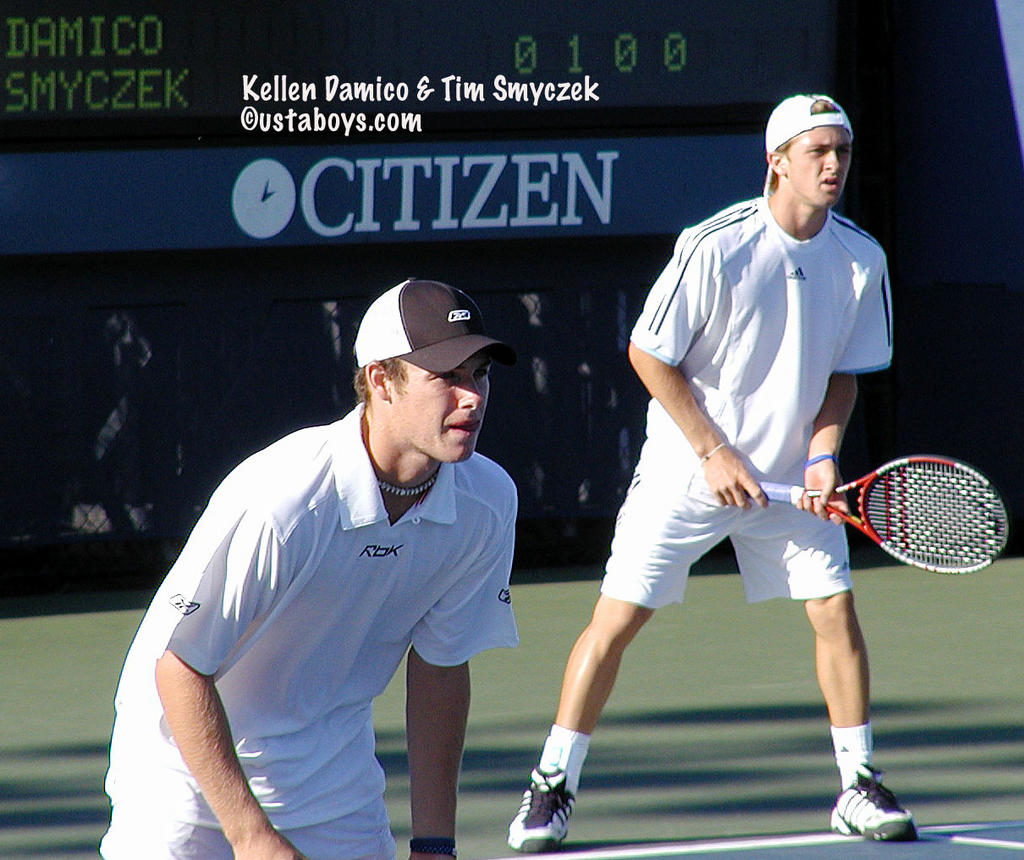
In doubles, two American teams reached Friday’s semifinals. Young and partner Alex Clayton advanced over Smyczek and Kellen Damico 6-1, 7-6 (5). Wimbledon champions Jesse Levine and Michael Shabaz, shockingly unseeded here, grabbed another straight set victory over Pavol Cervenak and Lukas Lacko.

Glatch and King, the second seeds, are the only U.S. team remaining in girls doubles.

For complete draws, including doubles action, see usopen.org

For more photos see ustaboys.com


Wednesday, September 7, 2005

Four More U.S. Boys Advance to Round of 16


--
Four More U.S. Boys Advance to Round of 16 at Open; Smyczek and Damico upend top seeded doubles team.

©Colette Lewis 2005--
Flushing Meadow, NY


First, I'd like to welcome all the readers of Peter Bodo's TennisWorld.

Peter's sitting next to me in the media center at the National Tennis Center and busy with the big boys and girls, although his post Tuesday is about Andy Murray vs. Richard Gasquet (still teenagers, and Andy could have defended his Jr. title here had he so desired.) But with the "Senior" events (as they so quaintly refer to the tours in Great Britain) winding down, Peter had a moment to join me at the Querrey vs. Belic match, and Jon Wertheim of Sports Illustrated was also at Querrey and Young's wins today.

Querrey's victory was routine, if you can call a match with a player nearly knocking himself out by walking into the umpires footrest at the changeover by that description.

Croatian Luka Belic was the unfortunate victim when the players were taking their court positions after the warmup, and unsurprisingly he lost the first three games. At the 3-0 changeover, a trainer was called to attend to the golf ball-sized lump that formed on Belic's forehead. A fifteen minute delay, which featured not just trainers, but suit-and-tie clothed doctors, finally ended with Belic returning to the court. The patiently waiting Querrey was fine with that.

"I didn't want to come all this way and get a retirement," Querrey said. "The delay didn't really bother me. The first game back I missed four easy shots, but after that I was fine."

Querrey's big serve (sadly no radar guns on outside courts, so I can't quantify) gave Belic fits, and the 13th seeded Southern Californian never faced a break point in his 6-3, 6-3 win.

For the second straight day, top seed Donald Young dropped the first set to a dangerous opponent, but again survived. Unseeded Venezuelan David Navarrete came in to the match with considerable confidence as the six-foot four-inch lefthander had beaten Young in their only prior meeting, at the 2004 Eddie Herr Championship's semifinal round.

"I started with a lot of confidence and I think he respected me from the last match we played," said Navarrete. "But I got tired after the second set, and he started playing much better. I know he's a great player."

Young, who gave away at least six inches and 50 pounds to his opponent, used his usual array of defense and guile winning the match going away--4-6,6-2,6-0.

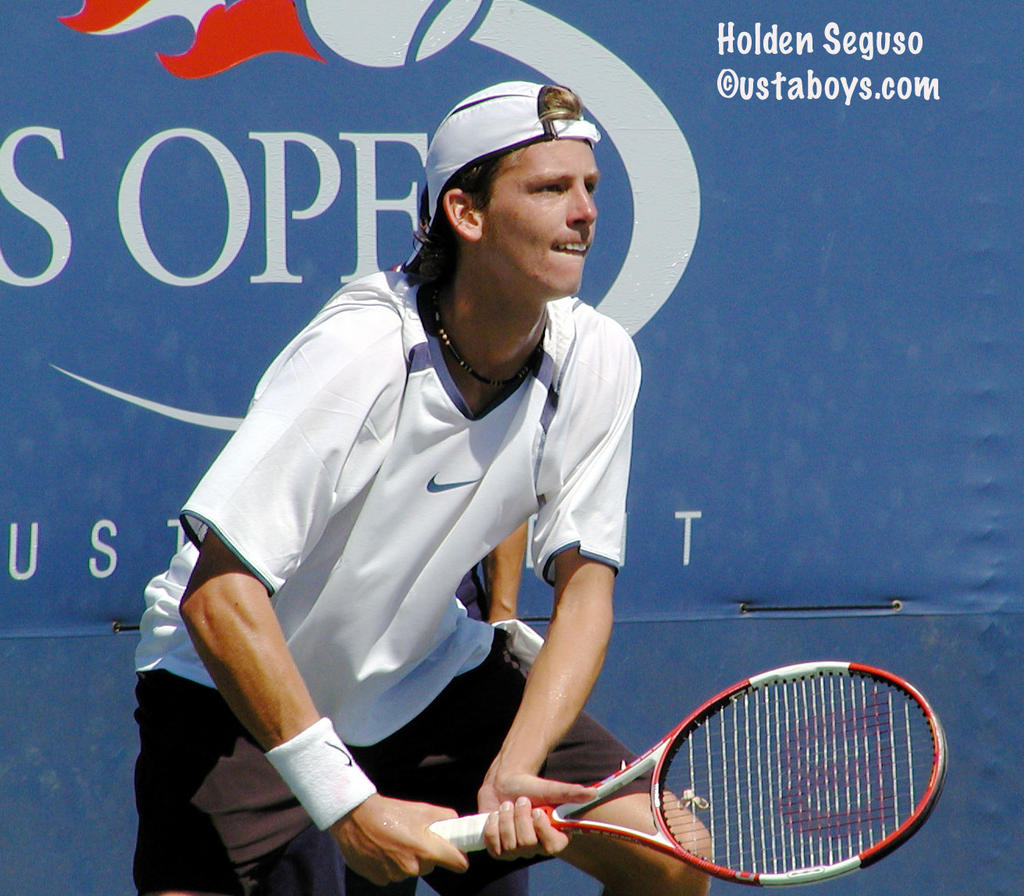
Unseeded Holden Seguso is making his first Grand Slam appearance a memorable one, with his second round 7-6 (5), 6-1 win over Lukas Lacko of Slovakia.

“This is my favorite tournament, “ said the slender righthander, who beat the eighth seed in the first round. “I’m competing well and playing well right now.”

Seguso got some tips from his junior friends on how to best counteract his opponent’s impressive game.

“I asked around the locker room, and the guys said if you work the point, he’ll start slapping it around, and that’s what happened.”

“It was also important that I get ahead, and I did.”

U.S. players joining Alex Kuznetsov and Tim Smyczek, (who played on Tuesday) in the round of 16 Wednesday were Querry, Seguso and Matt Bruch. Bruch, of Lake Forest Illinois, battled back to defeat lucky loser Rupesh Roy of India 3-6, 6-4, 6-3, his second straight three set match.

"In the first set I was missing my backhand," said the eighteen-year-old Stanford freshman-to-be. "I had never played him, and he was really quick, so once I started going behind him, I won a lot of points that way."

Michael Shabaz of the U.S. was serving for the match at 5-3 in the third set against Kenyan Christian Vitulli, but dropped the final four games of the match in the 4-6, 6-4, 7-5 contest. Please visit juniortennis.com for Annie Paton's daily wrapup story, featuring quotes from Vitulli.

On the girls side, tenth seed Vania King was the only U.S. player to advance. She beat compatriot Madison Brengle 6-1, 6-0, and has now lost a grand total of one game in her first two matches. National girls champion Mary Gambale lost a heartbreaker today to Sharon Fichman of Canada 0-6,7-5,6-4.

King joins Alexa Glatch and Liz Plotkin, who won second round matches on Tuesday, in the round of 16.


Smyczek and partner Kellen Damico took out the top seeded team of South Americans Leonardo Mayer and Andre Miele in straight sets.

"I wouldn't say they played great," said John Roddick, Damico's coach. "They weren't hitting winners all over the place. But they volleyed great and got a lot of balls back, which can win you a lot of matches on the junior level."

For complete draws, including doubles action, see usopen.org

For more photos see ustaboys.com
Tuesday, September 6, 2005

Plotkin Stuns Jr. Wimbledon Champion and Open's Second Seed


--
©Colette Lewis 2005

If the USTA has a copyright on perfect weather, the U.S. Open is collecting some serious royalties this week. Clear skies, low humidity and refreshing breezes have been relentless since we arrived in New York, leaving the tennis as the lone focal point.

Junior tennis is now taking center stage, and today’s diva was American Liz Plotkin, who earned one of the biggest victory of her junior career, taking out Wimbledon champion Agnieszka Radwanska 6-4, 6-4 in a second round singles match.

In fact, Plotkin, a seventeen-year-old from San Franciso, has now beaten the last two Wimbledon girls champions in the past year, having also beaten Kateryna Bondarenko at the 2004 Winter Internationals.

Plotkin is currently 36th in the ITF rankings, while Radwanska is third. But Plotkin, who did some scouting of Radwanska at Wimbledon, saw some positive signs in early in their first meeting. “We had a couple of really long games in the beginning and I really though I could have a chance to beat her,” said Plotkin. “She hits really flat and pounds everything, and actually I like that style. I like to have a poundfest out there.”

Plotkin also took confidence from her first round win over Marrit Boonstra.

“Once you get by a round with two tiebreak sets and you’ve fought your way through that, anything’s possible.”.

Plotkin’s win overshadowed another upset—Jamie Hampton’s elimination of fourth seed Caroline Wozniacki of Denmark in the first round. Hampton, a fifteen-year-old from Alabama, won the USTA 18s Clay Court Championship in July, and the wild card recipient put the fifth ranked Wozniacki on notice at the start, taking the first set 6-2. About the time she was expected to crumble, after dropping the second set 6-2, Hampton instead recharged and took the final set 6-4. Her reward—a second round match with unseeded but dangerous Yaroslava Shvedova, the winner of the ITF Grade 1 Canadian Open last week.

The boys’ top seeds negotiated the waters more predictably Tuesday. World number one Donald Young dropped the first set to a confident Phillip Bester, who was a finalist at the Canadian, but the top seed continued his domination of the IMG Bolliettieri Academy player with a 3-6, 6-1, 6-3 first round singles win.

Second seed Marin Cilic, the French Open champion, was also tested in his second round match with wild card Wil Spencer. Though down an early break, Spencer, who turns 16 on Thursday, fought back to force a first set tiebreaker. “I was too relaxed,” said the six-foot six-inch Croatian, who had beaten Spencer in last year’s U.S. Open junior qualifying tournament. Cilic played a nearly flawless tiebreak, and although Spencer pestered him in the second set, the ITF’s second ranked player prevailed 7-6, 6-4.

Alex Clayton, who was recently named a Davis Cup hitting partner for the U.S. team traveling to Belgium later this month, battled the 14th seed Evgeniy Kirillov of Russia to a third set tiebreak, but fell just short in a riveting match of high quality tennis. Kirillov won 4-6, 6-4, 7-6 (4).

Tim Smyczek, a Wimbledon semifinalist, was not seeded, but the 26th ranked righthander from Wisconsin certainly played at a higher level than Thiemo de Bakker, the ninth seed from the Netherlands, eliminating him 6-1, 7-6 (0) in a second round encounter.

Alex Kuznetsov, the fifth seed, defeated fellow American Dennis Lajola 6-3, 6-2.

Seeded U.S. boys to fall included 16th seed Jesse Levine, who dropped a 4-6, 6-4, 6-0 decision to Venezuelan Piero Luisi, and 2004 Orange Bowl champion Tim Neilly who also failed to win a game in his final set, although his was the second. He was defeated by Kei Nishikori of Japan 6-4, 6-0.
For complete draws see usopen.org

For more photos visit ustaboys.com

Monday, September 5, 2005

Radio Days


Radio Days--
©Colette Lewis 2005

Radio Days

I watched junior tennis today, but I also spent significant time promoting it, with the help of American Express radio. They were looking for juniors to interview for a live show before the evening session, and because I had Sam Querrey’s cell phone number, he and I were both recruited.

I was also asked to join Barry McKay at the top of Ashe Stadium to do a primer on Kalamazoo. At the Open, American Express card holders have free use of radios, allowing them to follow the CBS (or USA Network) commentary while watching matches on other courts. During the TV commercial breaks, McKay provides updates on other matches and chats with guests. Monday was junior day, and I was given plenty of time between the Davenport and Agassi matches to explain some of the history of the Kalamazoo tournament, and provide some background on players to watch in the junior event. I don’t think I stumbled too many times, and my confidence in my knowledge of the topic kept my nerves at bay.

And as I watched and listened to the evening live show, with Holden Seguso, Sam Querrey and Tim Neilly answering the often pointed questions of Nick Bollettieri and Jimmy Arias, I was impressed, again, by the poise of these teenagers and their willingness to put themselves out there, for no more payment than a US Open sweatshirt.

It was also interesting to be told by the producer that last year’s junior radio show, which featured Scoville Jenkins, Scott Oudsema, Brendan Evans and Phillip Simmonds, was the most popular of all the shows they did. So despite the general so-what attitude toward junior tennis of the majority of tennis writers in the media center, at least it has the support of American Express radio.

As for the tennis played in the almost boringly perfect weather, the U.S. boys had another good day. Querrey and Seguso won in straight sets, Seguso taking out the eighth seed, Niels Desein of Belgium, despite a nervous stomach that found him doing an Andy Murray imitation prior to the match.

Qualfier Matt Bruch, who enters Stanford in a few weeks, also eliminated a seed, taking out Andre Miele of Brazil in three sets. He and Seguso also teamed to take their doubles match later in the day.

Jesse Levine, the 16th seed and a recent semifinalist in Kalamazoo, also was a straight set winner.

The only American boy to lose Monday was Kalamazoo 16s champion Nate Schnugg, who fell to International Grass Court champion and lucky loser Rupesh Roy, 6-3, 6-4.

Top seed Donald Young and wild card Jamie Hunt play their first round matches on Tuesday.

The U.S. girls had a less successful day, with only four of the ten playing Monday leaving the court winners. The most impressive victory was posted by Vania King, who won three qualifying matches and one in the women’s main draw last week. She didn’t let up when she returned to the juniors, winning 6-0, 6-0 this morning. Also advancing to the second round were Julia Cohen, who upset 16th seeded Amina Rakhim, Mary Gambale, the reigning girls national champion and fourteen-year-old Gail Brodsky.

Lauren Albanese, a finalist at the Canadian Open completed on Saturday, and wild card Jamie Hampton are scheduled to play their first round singles matches on Tuesday.


Sunday, September 4, 2005

Clayton and Querrey Named Davis Cup Hitting Partners


--Clayton and Querrey Named Davis Cup Hitting Partners--
©Colette Lewis 2005
U.S. Davis Cup Captain Patrick McEnroe has asked juniors Alex Clayton and Sam Querrey to accompany the team to Belgium for the World Group Playoffs later this month. The United States must win the tie, which will be played indoors on red clay, to maintain its place in the world group. Andy Roddick and the Bryan twins are expected to play, although the team has not yet been named. Clayton, 17, won the National Clay Court 18s title in July, and Querrey, also 17, advanced to the quarterfinals of the French Junior Open in June. Both are playing in the U.S. Open Junior tournament in singles and doubles. They will practice with the team and be in attendance throughout the competition.