Zootennis


Schedule a training visit to the prestigious Junior Tennis Champions Center in College Park, MD by clicking on the banner above
Showing posts with label Sports Science. Show all posts

Saturday, March 7, 2026

Cozad, Yoshida Win ITF J200 Las Vegas Titles; Goode Takes ITF J300 Tucson Wild Card, Liutova a Late Withdrawal; Auburn Women Beat LSU, Texas Men Fall to LSU; Zheng Keeps AO Earnings


Ryan Cozad won his first ITF Junior Circuit singles title in more than year today at the J200 in Las Vegas, with the top seed defeating doubles partner Ford McCollum, the No. 10 seed, 6-0, 6-1. The University of Virginia recruit, who had claimed his ninth ITF Junior Circuit doubles title Friday, partnering with McCollum, dropped just one set in his six singles victories. Cozad now has three career singles title on the ITF Junior Circuit.

No. 5 seed Riyo Yoshida of Japan won the girls singles title, beating No. 2 seed Hollie Smart of Great Britain 6-3, 5-7, 6-2 in today's final. It's Yoshida's second ITF J200 title, and her seventh overall.

All four finalists are expected to compete in next week's ITF J300 in Tucson, but there was a late withdrawal, with Kristina Liutova pulling out today. That leaves Melije Clarke as the only current ITF Top 50 girl in the draw.

The girls draw in Tucson lost a top 50 player in Liutova, but the boys gained one with the notice that Gavin Goode has accepted a wild card into the main draw. The ITF Junior No. 23 was not entered in Tucson, although he did enter the San Diego J300 the following week.

The other main draw wild cards went to Justin Riley Anson, Dhakshish Aryan Basavaraju, Daniela Del Mastro, Julia Seversen and Tanvi Pandey.

The qualifying began today in Tucson, but there were very few matches, with the boys unable to fill a 24-player draw, with the five players with byes needing to win only one match to qualify for the main draw.

The girls did have enough qualifying entries for the standard 48 draw, but 21 players received byes into the second round. The second round winners will play two qualifying matches Sunday with those six winners playing another match in the main draw Monday.

At the J300 in Paraguay, No. 5 seed Damir Zhalgasbay of Kazakhstan won the boys title, beating No. 2 seed Yannik Alvarez of Puerto Rico 6-4, 6-4 for his first ITF J300 singles title.

Top seed Sol Ailin Larraya Guidi of Argentina won the girls singles title, her first at the J300 level, beating unseeded Camila Rodero of Chile 2-6, 6-4, 6-4.

Qualifying is underway for the ITF J300 in Porto Alegre Brazil, with Londyn McCord, the No. 1 seed, the only American in qualifying. 

Thara Gowda lost in the semifinals of the W15 in Canada, with top seed Ariana Arseneault(Georgia, Auburn) of Canada beating the 17-year-old qualifier from Michigan 6-3, 6-2. Arseneault will face No. 4 seed Dasha Ivanova in Sunday's final.

Last night in Austin, second-ranked Texas lost to No. 6 LSU 4-3 in SEC play, adding to the chaos atop the men's rankings, after No. 1 Ohio State fell to Baylor on Thursday night. LSU's Olaf Pieczkowski, a 21-year-old from Poland new to the Tigers roster, came from 5-2 down in the third set to beat Sebastian Gorzny 3-6, 6-3, 7-5 at line 1, clinching the fourth point for LSU. LSU won the doubles point and got wins at 2, 4 and 1 to pull off the upset. Texas is right back out there tonight, hosting No. 7 TCU.

The fourth-ranked LSU women hosted fifth-ranked Auburn today in Baton Rouge, with Auburn claiming a 4-2 victory. Auburn won the doubles point, but lost four first sets in singles. LSU quickly tied the match with a win at line 6, but victories for Auburn and lines 4 and 5, the two matches where they had won the first sets, put them back in the lead. And in the three remaining matches, Auburn had forced third sets, losing at No. 2, but getting a win at line 3 from Angella Okutoyi to clinch it, with line 1 unfinished.

Auburn is now 21-1, with their sole loss coming in the semifinals of the Team Indoor, to champion Georgia. 

Front Office Sports (thanks to Courtney Nguyen for highlighting the article in her Daily Bagel newsletter) has followed up on the issues of NCAA compliance regarding Michael Zheng's Australian Open earnings, with Zheng able to accept the money without jeopardizing his eligibility this spring because the money can be used for expenses throughout the calendar year, not the academic year in which it was earned. Whether the Reese Brantmeier settlement, yet to be announced, will affect this rule is unknown right now, but Zheng can fund the start of his pro career without any worries about the NCAA rules. 

The Universal Tennis Foundation's Hurd Award for American collegians was scheduled to be selected on Friday, with the announcement of the men's and women's winners and finalists expected Sunday, when Tennis Channel airs a special segment on  Zheng will have another source of funds for his pro career expenses when he receives that $100,000, which he does not have to use during this year. 

Monday, October 17, 2022

Center Claims Both Titles for Second Straight Week at J4 in Dominican Republic, Doubles Titles for Eissa and Hance on ITF Junior Circuit; Atlanta J4 Underway; FSU Professor Seeks Research Assistants for Tennis Project; Could Ivy League Schools Start Offering Scholarships?

The ITF JA Osaka Mayor's Cup produced one American champion in boys doubles and a finalist in boys singles, but although those were the biggest events on the ITF Junior Circuit calendar last week, four other Americans captured one singles and three doubles titles.

Sixteen-year-old Olivia Center won both the singles and doubles titles two weeks ago at the J4 in Santo Domingo in the Dominican Republic, her first on the ITF Junior Circuit. Last week, the left-hander from California repeated that impressive double, again at a J4 in the Dominican Republic, again unseeded in both draws, again partnering with Ginger Foster for the doubles title. Center, who has not dropped a set in her two singles titles the past two weeks, defeated No. 6 seed Sam Grosjean of France 6-4, 6-1 in the singles final. In the doubles final, Center and Foster defeated the unseeded team of Andrea De Bernardo of Venezuela and Daniela Rubio of Peru 6-2, 6-2.  

At the end of last month, Center's ITF Junior ranking was outside the Top 2000. After her past two weeks and four titles, she is now ranked 521.

At the J5 in Nicaragua, 17-year-old Aida Eissa won her first ITF Junior Circuit title in doubles, with Ece Gencer of Turkey. The top seeds defeated unseeded Gabriela Gomez of Spain and Charlotte Klein of Germany 6-1, 6-0 in the final. 

At the J4 in British Columbia, Keaton Hance won his first ITF Junior Circuit title in doubles, partnering with fellow 14-year-old Thijs Boogaard of the Netherlands. The unseeded pair defeated Adam Bojkovic and Canadian Emmett Potter, also unseeded, 6-4, 3-6, 10-8 in the final. 

Boogaard, who won the Les Petits As title in January and the European 14s championships this summer, also won the singles title, his first on the ITF Junior Circuit.

After a week off, the ITF Junior Circuit returned to the United States with a J4 underway now in Atlanta. The top two seeds in the boys draw are Santiago Padilla Cote of Mexico and Dylan Charlap. The top two seeds in the girls draw are Christasha McNeil and Brianna Baldi. All four are through to the second round after today's action.

Ryan Rodenberg, a professor at Florida State, recently tweeted about a opportunity available for two research assistants on a tennis-related study he is conducting. In case you missed that tweet, here is his synopsis and contact information. 

Starting Fall 2023, I am excited to offer up to two fully-funded PhD student positions for tennis-specific research. Current/former college and professional players are encouraged to apply.  All applicants must possess a college degree.  The positions would be full-time and in-person at Florida State University (FSU) in Tallahassee.  I have received FSU approval to pursue a major research project focused on how tennis interacts with math/statistics, physics, economics, and law.  For further details, please contact me.  My contact information is below: 

Ryan M. Rodenberg, JD/PhD

Professor

Florida State University                                                              

850-645-9535 (office)

rrodenberg@fsu.edu


It's really exciting to have tennis the subject of academic research, and I look forward to hearing more about the project as it gears up.


Ivy League schools are Division I, but they do not offer athletic scholarships. This Connecticut Post article looks at the expiration of the law that codified that anomaly and what it might mean for the Ivy League in the future. The article focuses on Yale and on basketball, but it does raise interesting points about the advantages and disadvantages of a student-athlete choosing to attend an Ivy League school, and that includes many junior tennis players. 

Monday, May 11, 2020

Billie Jean King Talks Coaching on USTA Player Development Learning Series; North Carolina Women's Seniors Announce Their Return for 2020-21 Season


Billie Jean King was the special guest on today's USTA Player Development Learning Series Webinar, entitled "The Future of Great Female Tennis Coaches and Players."

The 76-year-old King has a virtual lifetime of tennis experience, and while she is most famous for founding women's professional tennis, she also has provided coaching for some of the world's best players. Here is what King had to say about coaching Martina Navratilova, who was working with Craig Kardon on a daily basis, but also consulted with King.

"We'd sit down, the three of us, say we're going to the office, and we'd discuss what does it mean to be in the moment, what does it mean to be in the now," King said. "We'd have these long discussions, Martina would talk about, Craig, and then at the end, I'd say Martina, if I had to tell you one word during practice, what would you want me to say about staying the now?  And she'd go, just tell me the word 'now'. My job was to learn what she wants. And when she was practicing, I would just say 'now'. If I thought she lost focus, gone away, wasn't all present."

There was some debate on this site about the glossary I posted from last week's Learning Series webinar, so I was interested to hear this from King:

"It's very important to learn the other person's vocabulary," King said. "Point of contact? What do you want to call it? I had one kid in Hawaii who said, 'I want to call it sexy.' I said ok, whatever you want; you want to have fun."

King, who persisted after the men's pro tour rejected her offer to partner with women back in the early 70s, had additional advice for women who want to coach tennis.

"One thing is important," King said. "Do not take anything personally. This is for all the young people out there, the parents, all the coaches, administrators, conditioning coaches: I think it's really important to teach a child at a young age not to take things personally. It's really helpful."

With commencement speeches pertinent at this time of year, King said there are three things she always highlights when she is asked to give one.

"Relationships are everything. And that means with yourself and with others; family, friends, faith, whatever. No. 2, keep learning and keep learning how to learn. As a player, if you want to be pro, you better do that every single day. Keep learning and keep learning how to learn. And No. 3 is be a problem-solver. Be curious, find out things, that's going to help you. That's all we are as a jock, as an athlete, as a player. Every ball coming to you, you have to make a decision, you live with it. Never think as making a mistake as a failure, it's feedback. When you win, it's feedback."
After King's session with USTA head of women's tennis Kathy Rinaldi, USTA's Jennifer Fallon provided gender-specific tips on strength and conditioning, fitness and mental training for women.

The USTA's mentoring program was next on the agenda, with USTA Player Development's Jessica Battaglia hosting a panel with mentor Walker Sahag and her mentee, former University of Alabama play Emily Zabor. Sahag and Zabor talked about the USTA's role in encouraging their relationship, and what both have learned from the experience.

The complete webinar, which runs 90 minutes, is available at the PD Learning Series website.

Next week's Learning Series webinar will feature Jose Higueras and Jim Courier, with the topic "Maintaining Strong Player and Coach Relationships."  Registration for this webinar, scheduled for Monday at 3 p.m. EDT, is available here.

The University of North Carolina women, who won the ITA National Team Indoor title this year and would have been the favorite for this month's NCAA team championships, announced today that all three seniors would be returning for a fifth year in 2020-21. Alexa Graham, No. 3 in the final ITA rankings,  Sara Daavettila, No. 5, and Makenna Jones, No. 52, will be joined by the Tar Heels' excellent recruiting class, which includes blue chips Fiona Crawley and Reilly Tran and five-star Sara McClure.

Thursday, November 21, 2013

Fenty Downs Mayo to Win USTA's Boys 14s Les Petits As Playoff; Can These Three Words Stop Choking?


The three-day playoff for two spots on the USTA's boys team that will travel to Bolton and Tarbes in January was completed today in Boca Raton, Florida.  Andrew Fenty defeated Keenan Mayo 6-4, 6-1 in the match that concluded the competition for those born in 2000, with both players reserving their places on the team.  Adam Neff, the top-ranked player born in 2001, was also included in the the playoff. The other two players who will travel to the Teen Tennis and Les Petits As tournaments will be selected by the USTA at a later date. 

Fenty, who trains at the Junior Tennis Champions Center in College Park, Md., went 5-0 in the playoff. Thursday's complete results are below:

Finals:
Andrew Fenty def. Keenan Mayo 6-4, 6-1


Semifinals:
Keenan Mayo def. Robert Baylon 7-5, 6-1
Andrew Fenty def. Roscoe Bellamy 6-4, 6-2
3rd place match:
Roscoe Bellamy def. Robert Baylon 6-3, 6-3

Consolation :
Axel Nefve def. Adam Neff 6-4,6-3
Brain Shi def. RJ Fresen 6-3,6-4

5th place match :
Brian Shi vs Axel Nefve .....Unfinished due to rain

7th place match :
Adam Neff vs RJ Fresen....Unfinished due to rain


Dan Coyle, the author of The Talent Code, posted the results of a recent study of performance under pressure on his blog. Ambushed into singing karaoke, subjects were asked to say one of three three-word phrases prior to taking the stage:  "I am calm," "I am anxious," or "I am excited."  They were then graded on their performance. The calm group peformed the worst, followed by the anxious, with the excited group getting the best scores. 

Coyle discusses the possible reasons for these results and what they might mean for anyone seeking to control their emotions under stress. Tennis has plenty of situations where there could come in handy, so take a moment to read the entire post.

Saturday, September 29, 2012

Guest Post from Coach David Hodge: Is the “trophy position” really the trophy position?

(This is a guest post from David Hodge, who I know from his years as the assistant men's coach at Stanford University. He moved on to his native Australia where he was a national coach for Tennis Australia. See the bottom of the post for his more complete bio.)

Remember that first tennis trophy you won? 

Think back. It seemed mammoth. You weren't sure how you actually fit it on your shelf next to your other worldly belongings. 

They all had the same construction – base with an engraving like mine “MDJTA Inc. 1993 Pennant Mens Doubls Champions D Hodge & B Hodge”. Yes, they failed to put the “e” in doubles but I only noticed that after the euphoria had died down decades later! On top of that base were tall columns of the cheapest gold embossed plastic made.

It is one trophy I've kept, a memorable title with my father, Bob. But this isn't about the story that has grown to be my epic triumph at a small tennis club in the country as a kid. It is about what stood atop that base and column that is referred to incessantly in clinics and private sessions by coaches all across the world. On the apex of that trophy, sitting gallantly, like a golden god, was the iconic serving man.

He represented success, league standings, past triumphs, and everything that was cool about the skin tight short shorts of tennis' yesteryear. He has been coveted, presented, mimicked, frozen, used and abused throughout tennis history. He's got more gold draped over him than Andy, Serena, and the Bryans put together. But what has stood the test of time more than all that, is that position. The trophy position. Mid swing, mid flow, casually held as if he were waiting for a bus. 

All photos supplied by David Hodge
I sense that recollection on your face now.

This phrase as been uttered so many times to unsuspecting hackers that most people have been numbed by the reference. Technically should we, as tennis professionals, still be using it at all? The serve is basically a throwing motion, fluid and loose. So to freeze a rigid moment in that fluidity can be confusing to even the most coordinated youngster. We will call it mid swing or preparation phase and move on.

Let's take a look.

•    He has little knee flexion. Ideally his back knee flexion would measure 110+/-10 degrees, so he won't be able to use ground force reaction (GRF) to begin the summation of forces required to create power. Remember this mold would have been created a long time ago when serves were predominantly used to start the point, not end it!
•    His toes are facing slightly different directions meaning GRF will be impeded. For efficiency sake keep your toes facing the same direction to keep your muscles working together.
•    He demonstrates a “foot back” technique. Foot back and foot up technique have both been effective on tour.
•    Hip tilt is present based on the waist band of those trendy shorts, but the left hip is unlikely to have crossed the baseline plane as it should (unless he's committing a sneaky foot fault!).
•    Shoulder tilt is present. The first separation angle is present between hip and shoulders on the vertical plane.
•    His shoulders are rotated slightly further than the hips creating a second separation angle around the twist axis or horizontal plane. His little plastic muscles of the trunk are now pre-stretched.
•    His tossing arm is extended (but I can't remember the last pro I saw keep the second ball in the hand!).
•    His hitting arm is elevated slightly above the line from shoulder to shoulder extended, i.e. his right elbow is not in line with his right and left shoulders.
•    His right elbow is at 90 degrees.
•    There isn't any wrist lag evident.
•    Grip would have to be eastern to allow the racquet face to be pointing in that direction considering the wrist position. Ideally you would keep a continental grip although we now see some eastern grips on serve e.g. Tsonga
•    And hair nicely coiffed and slightly breeze blown...ok, I'm getting carried away.

And if you don't want to take my word for it, how about a lesson from these two guys? You may have seen them before. I won't waste space introducing them. Two of the best servers statistically of all time (and they did some other stuff pretty well too).


So overall, the trophy position has a lot of the characteristically good positions for a solid serve but they are under utilised. This again would be consistent with the serve's use when this position was created. Nowadays, the serve is such a dominant weapon, especially in the men's game, that the nonchalant server is virtually extinct. My advice to the trophy man would be:

•    Increase his knee flexion to the required degree
•    Whatever stance you use, once planted, keep your toes facing the same direction.
•    Increase hip extension into the court, which should increase shoulder tilt from the side view
•    Increase shoulder rotation around the twist axis when compared to the hips
•    Get rid of that ball in your left hand!
•    Keep your right elbow at 90 degrees but relax it slightly to bring it in line with your shoulder tilt.
•    Relax the wrist, allowing it to lag through the preparation phase
•    Experiment with a continental grip. With the above changes you just may like it.
•    Get an up-to-date haircut and save on some products ok!


The Topline Trophy shop doesn't exist anymore behind the old car service station that shared an intersection with 2 pubs and a church. It's hard to outlive a pub or church in my hometown! But if the trophy shop was still there and those serving men on those trophies could talk, I'm sure they would want to be melted down and re-shaped to match the modern masters.

David Hodge is a career coach and organisational leader with a wealth of experience. He is a manager for Aussie Athletes Agency, the premier college athlete recruiting agency in Australia. He is also the Founder and Director of Return Serve, which is a not-for-profit, volunteer-based organisation committed to creating opportunities to the broader community, assisting elite competitors, and educating coaches. Previously, as the Head National Tennis Coach for Tennis Australia he produced 42 Australian National Champions and 38 Australian representatives. His career has spanned the professional circuit, U.S. College Tennis (Stanford University and the University of Colorado) and numerous academies and clubs. He has coached 19 players inside the top 1000 ATP/WTA rankings, 18 players inside the top 100 in Australia, and 7 players inside the top 100 ITF rankings, including a world number 1, Wimbledon junior finalist and champion. Follow him on twitter @CoachDavidHodge.


Saturday, June 16, 2012

Loeb, Kerznerman Win ITF Grass Court Titles; Marand Reaches Final in Bethany Beach 10K; Study Questions Conclusions of Ten Thousand Hour Theory


Jamie Loeb's ITF junior circuit winning streak continued today when she defeated Usue Arconada to claim the girls singles title at the ITF Grade 4 International Grass Court Championships in Philadelphia, Pa.

The unseeded Loeb, who won the Delray Beach Florida Grade 4 on clay last month, defeated the 13-year-old Arconada, who now trains at the Junior Tennis Champions Center in College Park, 6-3, 6-3 to extend her winning streak to 11 matches. As in Delray, Loeb did not lose a set en route to the title.


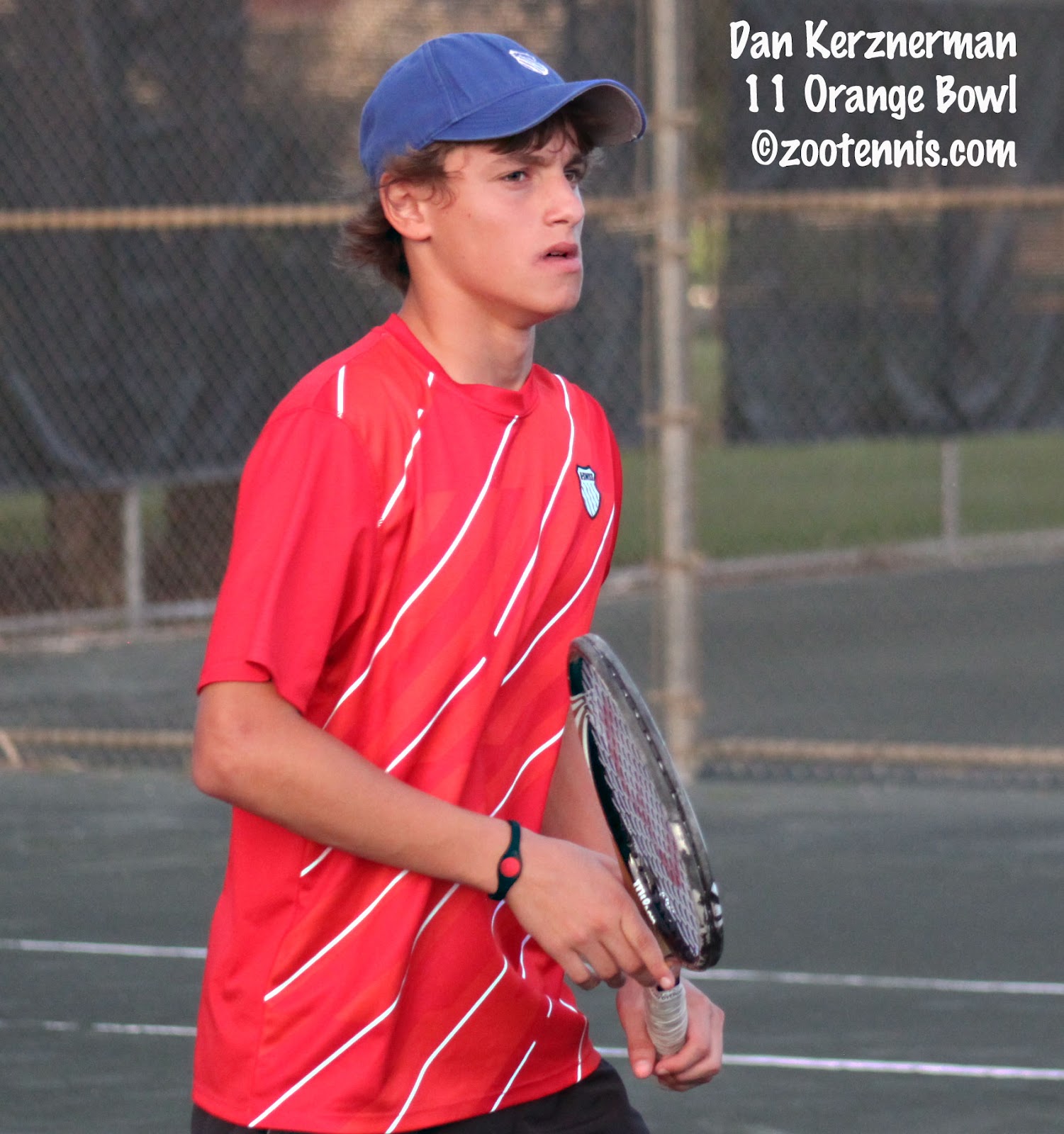
Another player with New York roots also put together a clay/grass double with a victory today in Philadelphia. No. 5 seed Dan Kerznerman's 6-3, 3-6, 6-1 win over doubles partner Henrik Wiersholm, the No. 4 seed, was Kerznerman's second ITF Grade 4 title in the past two months. He won the ITF Grade 4 in Plantation Florida early last month.

The complete results are available at the TennisLink site.

With the completion of the Grass Courts, there are no other ITF tournaments in the United States this summer until the Grade 2 International Hard Courts, which are moving from New Jersey to College Park, Maryland. That tournament, which will include hospitality for the first time in several years, is scheduled for August 20-25.

At the $10,000 Bethany Beach Pro Circuit tournament for women, former University of North Carolina All-American Sanaz Marand has reached both the singles and doubles final.  The unseeded Marand, who graduated from UNC in 2010, defeated top seed Alexis King in the semifinals today 6-4, 3-6, 6-3 and will play another unseeded player, qualifier Vojislava Lukic of Serbia in Sunday's championship match. The 25-year-old Lukic, once ranked as high as 203 back in 2007, has basically been off the tour from 2009-2011.  Marand is playing doubles with Jacqueline Cako of Arizona State, and they are the No. 3 seeds.

For the draws, see the Pro Circuit results page at usta.com.

Thanks to Parenting Aces for tweeting the link to this study, What makes champions? A review of the relative contribution of genes and training to sporting success posted on the International Tennis Performance Institute's Facebook page, which casts a critical eye on the 10,000 hours theory of accomplishment. That theory, proposed by  K. Anders Ericsson, a professor of Florida State, links the acquisition of skill to that particular number of hours of practice. The authors of this study believe genetics are more important than Ericsson gives them credit for and go on to explain why they believe Ericsson is incorrect. It's just another of the many nature vs. nurture discussions that have filled academic journals for as long as there have been such outlets, but it is interesting reading.

Thursday, November 10, 2011

Resources for Tennis Parenting

I am working on an article about tennis parenting for the National Championships Magazine, which is distributed by the USTA at major junior tournaments.

Most of you know that I'm not, and have never been, a tennis parent, so I suppose not having lived the life, my observations would always be missing a key ingredient. But during the past decade I have witnessed many parent/child, parent/coach, coach/child interactions, and I hope some of what I've learned and seen during that time may prove valuable to those embarking on the journey.

The past two weeks I've been talking with parents, players, coaches and parenting experts about the subject (if you want a good conversation starter, ask someone what advice they would give tennis parents) and feel it's important to share some of the resources I've discovered now. Due to space restrictions, the article will barely scratch the surface of the subject, so I think providing these links may benefit those who want to go deeper.

I believe I've mentioned Dr. Larry Lauer's blog Tennis Mental Edge recently, but the Director of Coaching Education and Development at Michigan State's Institute for the Study of Youth Sports also has much to offer in the realm of sports parenting in general and junior tennis in particular. Please check out the ISYS website for links to courses and studies, which in one case will direct you to the USTA website for more on tennis parenting.
(If you are interested in his reaction to the Penn State scandal, and its relevance to all coaches, with suggestions for parents in protecting their children, see his post today.)

David Benzel has been doing presentations at Regional Training Camps for the USTA, and also told me he has been hired by individual clubs to give advice about navigating the parent-child relationship when sports play a big role in it. His website, growingchampionsforlife.com, provides many free tips, and also he also offers a subscription "Inner Circle", for additional information.

Although TheTennisMom.com has been on hiatus for most of the year, there is still great content available for viewing there.

Another tennis parent blog, parentingaces, has emerged on the scene, and in the past two days, there have been two informative posts on choosing a tennis coach for your child. And don't miss the post Sometimes It's All About Me, about her very natural emotional investment in her son's tennis, how it developed and why it's hard to let go of it.

Yet another website has surfaced recently, not specifically about parenting, but still of interest to those entering or occupying the junior tennis world. Called CATennis, there have already been over 100 posts since October, so select the topic of interest to you and start reading.

Friday, October 21, 2011

Falconi Wins PanAm Gold over Puig, Farah into Men's Final; Other News and Notes from Around College and Junior Tennis


With a 6-3, 6-2 victory over seventh seed Monica Puig of Puerto Rico, former Georgia Tech All-American Irina Falconi became the first US woman to win the singles gold medal at the Pan American Games since Pam Shriver in 1991. Falconi, the No. 2 seed, did not lose a set in her five victories in Guadalajara, Mexico this week. Top seed Christina McHale took home the bronze medal, beating Florencia Molinero of Argentina 6-1, 6-1. For an Associated Press story on Falconi and McHale, prior to their matches today, see usatoday.com.

The men's final will feature the other ITA Player of the Year in 2010, Rob Farah of the University of Southern California. The eighth seed, Farah defeated No. 7 seed Victor Estrella of the Dominican Republic 6-4, 6-4 in today's semifinal to earn his shot at a gold medal against No. 4 seed Rogerio Dutra of Brazil. Farah, who has already played five matches in the larger men's draw, also has yet to drop a set.

For results, see the Pan American Games website or the wikipedia page.

In other news, the University of North Florida has named former Wilson junior and college manager and Northwestern assistant Adam Schaechterle to the head coaching position there. Schaechterle joins former NCAA champion Audra Cohen, who was named the women's coach last June.

Taking over the men's head coaching position at Cornell is former University of Oklahoma assistant Silviu Tanasoiu. As Tony Bresky was before him, Tanasoiu will also be the Director of Intercollegiate Tennis at the Ithaca New York university.

Former University of Hawaii standout Dennis Lajola is embarking on his professional career after four years of collegiate tennis. Lajola is featured in this article, which was brought to my attention by a longtime reader.

The USTA's college spotlight shines on Division III All-American Gabrielle Clark of Emory. Clark talks about her decision to attend a Division III school, her goals for her sophomore year and how her hometown of Chicago compares to Atlanta.

In December, USTA Player Development is holding a Tennis Performance & Injury Prevention Conference. The two-day conference is December 10th and 11th in Tampa, Fla., with the cost $199. There will be a performance track and a injury/medicine track, and it is open to anyone. If I were not covering the finals of the Orange Bowl that weekend, I would consider attending myself. For more information, including a list of presenters, see the conference website.

And finally, I don't often run across articles critical of high school tennis fans, but there is one foreign exchange student in Mishawaka, Indiana who didn't enjoy his encounters with "rude" fans, according to this column in the South Bend Tribune.

Wednesday, September 21, 2011

Coach's Q and A: How Do I Know if I Should Retire in a Match?


Harold Solomon of the Harold Solomon Tennis Institute in Fort Lauderdale, Florida provides some insight into the delicate question of player retirements in this installment of Coach's Q and A.

Today's question: Retirements seem to be on the rise in pro tennis. How does a junior coach or parent know when their player should consider retiring from a match? How do you balance the health and safety issue with the desire to be seen as a tough competitor?

Tom Downs, director of coaching at the Harold Solomon Tennis Institute, responds:

Health and safety are of paramount importance for young tennis players. We think that it is important for players and parents to be clear about the risk/reward ratio for playing in situations which might cause long term damage to a players career.

Rarely do professional or elite junior players play matches where their bodies are 100%. That said, there is a big difference between playing or continuing a match where a player has obviously seriously injured a part of their body and continuing to may cause long term damage, and playing with a minor injury such as a blister, minor ankle sprain, or strained muscle.

There have been too many examples of professional players being determined to try and gut out a victory with an injury, when by continuing to play with that injury, they have actually put their careers in jeopardy. We believe that when a trainer tells a player that they are at risk of further injury or aggravating an injury, they should stop.

It is important to recognize how many players also try to come back too soon from injuries and once again put their careers in jeopardy. It is our belief that you always err on the side of caution. It is easy to get caught up in the moment of an important match or tournament but it is necessary to be able to keep everything in perspective and make sure that decisions regarding a player's health and well being are oriented toward the long term.


Harold Solomon adds:
Of course players are always dealing with minor injuries, most of which are not going to have long term effects on a player's career if they continue to play on. There is a fine line between a legitimate match-ending injury and one that is nagging, and it is important that players not use those nagging injuries as a back door to stop competing in a match. I never remember retiring during a match. I always wanted to respect my opponent and let them have a real victory rather then a default. I hate when I see players retiring being down 5-2 or 5-0 in the last set. Unless you are in serious physical trouble you always should have the character to finish out the match and walk always with your head held high.

Do you have a question for Tom or Harold? If so, please send it to clewis[at]zootennis[dot]com with the phrase Coach's Q and A in the subject line.

Thursday, September 15, 2011

What Explains Lack of Injury Retirements at US Open Junior Championships?


Once the rain became the top story during the second week, the theme dominating the first week of the US Open, the record number of retirements, slid into the background. But I decided to follow the trend through the junior championships to see if the numbers were similar, and they most certainly were not.

First, the numbers for the men's and women's singles draws. There were 10 men (correction: 11, with Tipsarevic's retirement in the quarterfinals) and four women who started a main draw singles match and did not complete it, which was not only a US Open record, but an Open Era Grand Slam record. I would guess that the men's side produced so many more due to the best-of-five format, where continuing seemed like too big a mountain to climb, but that's just speculation. (It would be interesting to see the statistics on the percentage of retirements when trailing in a match versus leading). It also should be noted that all of these retirements came in the first three rounds (the women also had two walkovers in the second round), so there were none in the second week.

For the juniors, the week started perfectly. In the first round, held over two days--Sunday and Monday--all 64 singles matches ended conventionally. Monday was the first day for doubles, and it brought the first retirement, when the team of Natalija Kostic and Ayaka Okuno retired, down 6-1, 3-0 to eventual champions Irina Khromacheva and Demi Schuurs. Then came two days of rain, and no junior matches were played. On Thursday, indoors at the Sound Shore Club in Port Chester, there was one retirement, when Jessica Pegula retired in her second round match with qualifier Su Jeong Jang with the score 0-6, 6-3, 1-0. Pegula had her thigh wrapped with ice after the match, and perhaps the fact that she would have to play a second match yet that evening if she had won that third set may have figured in her decision. But, as it turns out, that was the beginning and the end of the 2011 US Open junior championship retirements.

It's true that the girls doubles draw took a hit on Friday, when six teams received walkovers, most likely due to the prospect of three days without having a doubles match scheduled, although it should be noted there were no walkovers in the boys doubles draw.

I thought I was going to see the second singles retirement in singles on Friday, when No. 6 seed Yulia Putintseva cramped badly in the third set against Nicole Gibbs, but after treatment, Putintseva, known for her often confrontational and ultra-competitive demeanor, finished the match.

Those juniors who kept winning played an enormous amount of tennis on the last three days of the tournament, but still there were no additional breakdowns. The 94 boys matches in singles and doubles produced zero, none, not one, retirement or walkover. That is amazing, but I have no plausible explanation for it.

Is it fair to think the money the professionals receive, which is $19,000 even for a first round loss at the US Open, provides an incentive to play when not fully healthy? Is there so much money at stake in a career that professionals will not risk the slightest chance they could make the injury worse? Is the game at the highest level played with such sheer force and athleticism that it isn't possible to avoid injury, especially after a long hard court season?

I don't have any answers, but I do know the juniors, who are constantly being unfavorably compared to the pros, surpassed them in sheer toughness this time.

Sunday, August 28, 2011

Notes From All Over Before Start of US Open

The next two weeks will be devoted primarily to coverage of the US Open, with onsite coverage of the Junior championships beginning Saturday, so in today's post I'll be doing some quick updates on other tournaments, articles and resources, with just a few related to the US Open.

Congratulations to Denise Starr, who won the ITF Grade 4 US International Hard Courts in New Jersey, beating Chalena Scholl, also of the US, 6-2, 6-3 in the final. Top seed Marco Aurei Nunez of Mexico won the boys title, beating unseeded Ognjen Samardzic of the US 6-2 6-3. Scholl and Katrine Steffensen won the girls doubles, with Jordan Daigle and Daniel Kahnin taking the boys doubles.

The Grade 1 Canadian Open is underway in Repentigny, with Jiri Vesely of the Czech Republic and Ashleigh Barty of Australia as the top seeds. Only two US boys are in the draw--qualifier Richard del Nunzio and Mitchell Krueger--but there are 9 US girls in the 48-player draw: qualifiers Blair Shankle, Sachia Vickery and Alexandra Morozova, as well as Kelsey Laurente, Allie Kiick, Grace Min, Tristen Dewar, Julia Elbaba and Christina Makarova.

As I tweeted just a few hours ago, Brett Clark has earned one of the two US Open boys wild cards still available by winning a tournament at Boca Raton, according to this brief story in the the Naples News.

Hayley Carter was given a wild card into the juniors earlier, along with seven other American girls. Carter is the subject of this feature in the Columbia, South Carolina The State. Having never once seen Carter play, she is near the top of my must-see list, along with Wimbledon girls champion Barty.

This Shreveport Times feature on Ryan Harrison, who plays his first round match against No. 27 seed Marin Cilic of Croatia first thing Monday on Louis Armstrong Stadium, provides an interesting glimpse into the mindset of the confident 19-year-old.

Doug Robson of USA Today looks at the global reach of tennis and how that has, or should have, changed the expectations for American success in the sport. I don't really agree with Billie Jean King's final quote, because I don't think it's even possible to identify future champions at a young age, but getting more youngsters playing and competing can't hurt.

New Yorker Lena Litvak, who played at Harvard for a year before turning pro, is the subject of this article in the Riverdale Press.

Eight-time Grand Slam champion Ivan Lendl has opened a tennis academy on Hilton Head Island with New Zealand's David Lewis the director of coaching.

Larry Lauer, the Director of Coaching Education and Development
The Institute for the Study of Youth Sports at Michigan State University and a co-author of the USTA Mental Skills and Drills Handbook, has started a new blog entitled Tennis Mental Edge. His first posts explore the attitudes of Novak Djokovic and Rafael Nada, and on the reasons Mardy Fish is a true US Open contender.

And finally, there is a new website, a part of Find The Best, that provides information on tennis clubs to assist those looking for a play to play, whether on vacation, after moving to a new community, or as an alternative to their current club.

Monday, July 5, 2010

Coaches Q and A: Should I Try Nadal's String?


Babolat's new string has become a hot topic in tennis, so we asked Andy Brandi of the Harold Solomon Tennis Institute in Fort Lauderdale, Florida for his thoughts are on the trend.

What do Rafa Nadal, Andy Roddick, Jo-Wilfried Tsonga, Sam Stosur, Franchesca Schiavone and Maria Sharapova all have in common? They all use Babolat’s RPM Blast.

Introduced in January at the Australian Open the RPM Blast string is taking the tennis world by storm, with players gravitating to this string in droves. What's behind this trend?

The RPM Blast, which is black in color, is easier on the arm. It increases spin because it grips the ball during contact and it shoots the ball out of the racket faster for more power. It gives unique feel.

Rooney Levine, who is with Match Point in Fort Lauderdale, says that 25% of those brining rackets for stringing are asking for RPM Blast. She mentions that it easier to string and is replacing Babolat’s Pro Hurricane Tour as the string of choice.

After hitting with it, I would recommend that juniors and female college players use it in a hybrid form. It would allow them to take advantage of the characteristics of the string while being easy on their arms. Be sure that you string it a little looser for better response. Older boys and college age male players can venture into stringing the whole racket with RPM Blast. Because of their added physical strength, it will allow them to take advantage of the string without harming their arm.

So my advice, if you have not tried it, get to your stringer. It will give you an added advantage.

Best of luck!


For a further information on this topic, see Doug Robson's recent article for USA Today.

Do you have a question for Andy or Harold? If so, please send it to clewis[at]zootennis[dot]com with the phrase Coaches Q and A in the subject line.

Saturday, March 27, 2010

Sell, Bouchard Win Uruguay Bowl; Sarmiento Takes Doubles in Philippines; Tennis Parents Sybil Smith and Rob Krajicek

A quick update of the results this week on the ITF Junior Circuit. At the Uruguay Bowl, Karue Sell of Brazil and Eugenie Bouchard of Canada won the singles titles at the Grade 2 event on clay. Bouchard, who was out with an injury for three months after her win at the B1 in Tulsa has played sparingly since the first of the year, primarily because she lost in the first round of three major tournaments--the Loy Yang Grade 1, the Australian Juniors in January and the Grade A Copa Gerdau this month. The second seed, Bouchard got her first win of 2010 in the first round and beat top seed Ulrikke Eikeri of Norway 6-7(5), 6-3, 6-1 in the final. Sell, who was a semifinalist at the 16s Dunlop Orange Bowl last year, was unseeded in Uruguay, but he breezed through the tournament without losing a set, defeating No. 4 seed Bruno Semenzato, also of Brazil, 6-1, 6-3 in the final.

At the Grade 1 Mitsubishi-Lancer International in the Philippines, Dane Webb fell in the semifinals to Australia's James Duckworth, but had a convincing win over No. 1 seed Mate Zsiga of Hungary in the third round. Raymond Sarmiento, who was the No. 2 seed, lost in the third round of singles, but teamed with Francis Casey Alcantara of the Philippines to take the doubles title. The pair had a match tiebreaker win over Webb and Mitchell Krueger in the quarterfinals. The Manila Bulletin had this story about the championship match.

For complete results of the tournaments, see the ITF junior website.

Charlie Bricker, writing for World Tennis Magazine, wrote this feature earlier this week about Sloane Stephens and her mother, Sybil Smith, and the contract the two have that helps them through the inevitable rough spots of being a tennis child and tennis parent. Smith talks about her background in competitive swimming, and how she has modeled her approach after her mother's.

This brings me to The Tennis Mom, which is a relatively new blog that I hope all tennis parents are reading regularly. Not only is Nicole a talented writer, but she is a what I am not--a tennis parent. I'm sure you will get a chuckle out of the first installment of her list of tennis parent types, as I'm certain you've all met or seen The Snob and The Wheeler Dealer at tournaments. And please make sure you read her profile of Rob Krajicek, the father of Texas A&M junior Austin, who has some very sensible advice based on his son's junior development experience.

And for more on the health and fitness aspects of junior tennis, don't forget Mary Jo Campbell's blog, MJ TennisFit.

Saturday, February 27, 2010

Vickery, Gibbs Invited to Compete at Billie Jean King Cup Monday; Hewitt, Tomic Reconcile; New Junior Tennis Health and Fitness Blog

If you've been following on Twitter, or via the Twitter feed at left, you know I was in Ann Arbor last night for the Michigan women's 4-3 win over Baylor. I'll have a complete account of this improbable Wolverine victory Monday for the Tennis Recruiting Network, and on Sunday, I'll try to recap all the results from the other big collegiate matches, including Stanford vs. USC, UCLA vs. Cal, Wake Forest vs. Tennessee and Florida vs. Illinois (men) as well as Duke vs. Florida, Tennessee vs. Notre Dame, Northwestern vs. Georgia Tech, UCLA vs. Stanford and Cal vs. USC (women).

Sachia Vickery and Nicole Gibbs have been selected to compete in the BNP Paribas Showdown for the Billie Jean King Cup at Madison Square Garden on Monday night, serving as an opening act for the exhibition that will feature Ana Ivanovic, Svetlana Kuznetsova, Venus Williams and Kim Clijsters as the main event. Last year, Sloane Stephens and Gail Brodsky were the future stars, and the year before that, it was Denis Kudla and Junior Ore. For more on Vickery and Gibbs, see this story from gvtnews.com.


Australia's Herald Sun is reporting that Bernard Tomic and Lleyton Hewitt have spoken by telephone and have resolved the feud that has been simmering between the two for over six months. Paul McNamee, who was unsuccessful in a recent attempt to win election to the Tennis Australia presidency, is said to have been instrumental in encouraging the reconciliation. That certainly makes an impressive entry on his resume, and the tug of war between McNamee and Geoff Pollard, Steve Wood and Craig Tiley, who currently direct Tennis Australia, will continue. Four Corners, which I gather is a 60 Minutes-type show in Australia, is conducting an investigation into Tennis Australia that will be aired on Monday.

And finally I'm happy to report there's a great new addition to junior tennis information on the web. Mary Jo Campbell, whom I know from her past position as a strength and conditioning specialist and athletic trainer at the USTA, has started a blog MJ Tennis Fit. MJ. as she is known, has already addressed the issue of sport specialization, growth-related injuries and pre-match warm ups, and promises many more tips and videos to help negotiate the challenges of playing such a physically demanding sport. This is a great resource for those who do not have access to a trainer and sports medicine expert, and knowing MJ, I am certain she would welcome any questions you may have. So subscribe, bookmark, or do whatever it is you do to keep up with information that is helpful to you. I'm sure her counsel and expertise will have you returning to the site regularly. And I also greatly appreciate MJ's mention of zootennis as an inspiration.

Tuesday, November 17, 2009

New Junior Tennis Podcast; Australia to Study "Hot Spots;" Learning From the French System

Andy Gladstone, Competitive Tennis Coordinator at USTA Florida, launched his new junior tennis podcast, called the G Cast, earlier this month, and he snared an impressive guest for his first episode, Patrick McEnroe. In the 26-minute podcast, which is available on iTunes, Gladstone asks McEnroe about his personal development as a junior, his vision for Player Development, college tennis, and what things he would change if he could just snap his fingers and have it done.

In the college tennis portion of the podcast, McEnroe presents what has been his consistent message--go to college unless it is obvious that you have the physical and mental maturity to succeed on the pro level at age 17 or 18, and are dominating on the international junior circuit. He also admits, for the first time that I'm aware of, that the USTA played a role in steering successful juniors away from college.

As for the finger snapping, he would like the USTA to have control of its own facility, which it does not have at the Evert Academy where the Boca Raton Training center is located, and would like to see changes in the Davis Cup format.

He repeatedly emphasizes the exchange and cooperation that the USTA is seeking with private academies and coaches; it sounds as if he is aware of the perceived arrogance and top-down approach that has caused resentment of the USTA in the past.

As reported in an Sydney Morning Herald article that had me immediately thinking of Daniel Coyle's The Talent Code: Greatness Isn't Born. It's Grown. Here's How,researchers at Griffith University in Australia are looking for the Wagga Wagga effect, or why some regions or towns are hot spots for athletic excellence. Coyle discussed this effect in detail in The Talent Code, with Curacao, Russia and South Korea producing inordinate numbers of Little League baseball players, women's tennis players and women's golfers.

"...over the next three years researchers would study factors such as the family support for elite athletes, whether there was a strong club system, socio-cultural factors, psychological factors, how recruiters perceived talent, home-town advantage and whether the hot-spots have strong socio-capital."

Neil Harman of the Times has made no secret of his disdain for the current management of the LTA, and in an article published Sunday, he contrasts that with the French system, which is now being steered by Patrice Hagelauer, who once worked for the LTA.

There are four elements to the Hagelauer philosophy - regional, national, international and coach education. At regional level, he says - "whatever we do as a nation begins in the clubs and the coaching in the clubs, in every department. This is what I was trying to develop in the UK. The imperative aspect is the junior programme, that those who are in charge of the players at 8, 9 at 12. There can be no mistakes at that age. We need the right ideas, but also we need to listen. It is about building a pathway to excellence.

"Then we have the national programme, with 14 centres of excellent across the country and we have to make sure we take care of those with better management systems. Everybody needs to work together. At the international level there are currently 32 players - double last year's number - who are working at Roland Garros. We have seven players in the top 100, 11 in the top 200 and many other junior players working through the rankings (Note to the LTA: we are only talking singles players here, doubles does not figure). It is important that players like Arnaud Clement and Michael Llodra, those with great experience, can mix with the younger ones, because they act as points of reference."


Is there enough of that mixing here in the U.S.? I actually believe it happens much more often than we hear about. Andy Roddick frequently invites top juniors to hit with him, not just at big tournaments, but at his home in Austin. Sam Querrey can be seen at Carson, and the mingling of top pros with juniors is common at Bollettieri's and Saddlebrook. With a country this size, it may not be realistic to expect everyone to converge in one spot, like Roland Garros, but I hope that the new National Center in New York can provide "points of reference" for the juniors there.

Tuesday, November 3, 2009

USTA Study of Junior Injuries Produces Troubling Numbers; Paul Roetert Leaving USTA; Delic Chats at Illinois

In an article today for Foxsports.com, Richard Evans writes of a study on junior injuries conducted from 2007-2008 by the USTA, which was recently presented at a coaches meeting at the Boca Raton Training Center. The numbers are not encouraging. Of the 861 players surveyed, 41 percent reported an injury, with 13 percent reporting two or more injuries. Although the article doesn't address this specifically, I'm assuming these are injuries that prevent a player from competing.

National coach Tom Gullikson is quoted as saying "it's worse than we expected," and those expectations were probably pretty low to begin with if you're around junior tennis players as much as someone like he is.

Evans explores three possible reasons for all the injuries: strings (the relatively new strings that allow for extended rallies), surface (the pounding that hard courts inflict on the body) and stress (pressure and expectations). There is a quote from Patrick McEnroe about the possibility of the Orange Bowl returning to clay, the surface that it was played on before it moved to Key Biscayne from Flamingo Park.

It would be extremely interesting to compare the injuries of junior players in this country with a country that has the majority of its training and tournaments primarily on clay to see how much of a factor this might be. (It may be possible to do this by just comparing the Southern California juniors with the Florida juniors, or at least the 12 and unders, as those in Florida do much of their training on clay.) If it's demonstrated that clay training does result in fewer injuries, it would add another plus to that side of the surface ledger.

Evans goes on to praise the dedication and attitude of the national coaching staff (although I believe he's mistaken in including Rodney Harmon, the former head of men's tennis among them) and the effort to address this important issue. As anyone who has followed tennis since the U.S. Open knows, it's a problem at the very highest level of the game too.


I don't believe there's been an official release, but Paul Roetert, the former Managing Director of Player Development and current Managing Director of Coaching Education and Sport Science, will be leaving the USTA at the end of the year. Roetert has also served as the tournament director of the US Open Junior Championships.

Amer Delic, the 2003 NCAA singles champion while at Illinois, is recovering from a knee injury and while unable to play, he is back in Champaign, finishing his degree. He did a chat today on the Fighting Illini website, answering questions about his decision to turn pro, breaking racquets, his favorite cities and when he might be back on the tour.

Friday, July 17, 2009

Book Review: The Talent Code by Daniel Coyle


Last month, in my review of Malcolm Gladwell’s Outliers: The Story of Success, I mentioned another book with a similar topic I was reading, Daniel Coyle’s The Talent Code: Greatness Isn't Born. It's Grown. Here's How.

Coyle’s book has as much or more relevance to tennis development as Gladwell’s. In fact, the impetus for his book is this article on Moscow’s Spartak Tennis Club that Coyle wrote for the New York Times' (now sadly defunct) Play Magazine back in 2007.

The “growing” Coyle refers to in that piece and throughout his book is centered on myelin, brain matter that neurologists believe may hold the key to skill acquisition. Coyle writes:

“It explains the world’s complexity with a simple, elegant mechanism. Skill is myelin insulation that wraps neural circuits and that grows according to certain signals. The story of skill and talent is the story of myelin.”

But you needn’t worry that the book is a scientific thesis. Coyle shows us other Spartaks: Curacao baseball, Brazil Futsal, Meadowmount music education, KIPP Heartwood Academy, revealing how these talent hotbeds conspire to produce greatness, while other, similar places do not. Why here and not there? he asks, and his answers are found in the book’s three sections: Deep Practice, Ignition and Master Coaching.

Although he cites the 10,000 hour expertise study that plays such a prominent role in Gladwell’s Outliers, Coyle adds this:

“Repetition is invaluable and irreplaceable. There are, however, a few caveats. With conventional practice, more is always better: hitting two hundred forehands a day is presumed to be twice as good as hitting one hundred forehands a day. Deep practice, however, doesn't obey the same math. Spending more time is effective—-but only if you’re still in the sweet spot at the edge of your capabilities, attentively building and honing circuits. What’s more, there seems to be a universal limit for how much deep practice human beings can do in a day. Ericsson’s research shows that most world-class experts—-including pianists, chess players, novelists, and athletes—-practice between three and five hours a day, no matter what skill they pursue.”

In the chapter entitled "The Three Rules of Deep Practice," Coyle explains the concept of chunking and how it relates to what he terms the HSE (Holy S**t Effect), “the feeling of seeing talent bloom in people who we thought were just like us, the feeling of where did that come from?”

“When chunking has been done effectively, it creates a mirage that gives rise to the HSE. From below, top performers look incomprehensibly superior, as if they’ve leaped in a single bound across a huge chasm. Yet as de Groot showed, they aren’t nearly so different from ordinary performers as they seem. What separates these two levels is not innate superpower but a slowly accrued act of construction and organization; the building of a scaffolding, bolt by bolt and circuit by circuit---or as Mr. Myelin might say, wrap by wrap.”

In Ignition, Coyle turns his attention what motivates people to undertake the tough work of deep practice. Sometimes it is a peer who breaks through—-Se Ri Pak in women’s golf, Anna Kournikova in women’s tennis, Andruw Jones in baseball. Sometimes it’s what Coyle refers to as the primal clues of a young life, “a vision of their ideal future selves, a vision that oriented, energized and accelerated progress, and that originated in the outside world.”

In the Master Coaching section, Coyle explores the successful coaching styles of John Wooden, Robert Lansdorp, Linda Septien, Larisa Preobrazhenskaya, Hans Jensen--the Talent Whisperers, as he calls them--and provides examples, through their teaching, of the four virtues of good coaching. And then he lobs in this curve ball in a section entitled Coaching Love:

“It’s the most basic common sense: if you want to start a child in a new skill, you should search out the best-trained, most John Wooden-like teach possible. Right? Not necessarily. [a University of Chicago study] discovered a surprising fact: many world-class talents, particularly in piano, swimming and tennis, start out with seemingly average teachers.”


Coyle then goes on to describe his local piano teacher, Mary Epperson, and how she is average in conventional teaching terms (that is, not famous), but is exceptional in “creating and sustaining motivation…teaching love.”

“As Bloom’s study summed up, ‘The effect of this first phase of learning seemed to be to get the learner involved, captivated, hooked, and to get the learner to need and want more information and expertise.’”


These are just a few of the many thought-provoking studies and observations that appear in Coyle’s book. If you read it, and I consider it essential reading for any coach or parent, there will be other insights that will resonate with you, that will alter the way you look at talent, practice and achievement. The book may not be the simple blueprint the “Here’s How” in the subtitle implies, but there’s no denying that the questions it asks and the conclusions it draws are a giant step toward understanding just what it is that constitutes that omnipresent and loaded word "talent".

For an interesting interview with Daniel Coyle, please see this entry at the blog "49 Writers."

To read the first chapter, see the book's website, which also contains an author's blog.

If you use the links to Amazon in this post, I will receive a small percentage of the sales made through this site.

Saturday, June 20, 2009

Book Review: Outliers, The Story of Success by Malcolm Gladwell


In a comment today, Jon King mentioned a frequently cited reason for the decline of the U.S.A’s tennis fortunes: the best athletes in this country don’t play tennis. It may be true, and I’ve been known to mention it myself when I’m asked for my opinion on the state of American tennis, but since I’ve read Malcolm Gladwell’s book Outliers: The Story of Success, I’ve begun to question that assumption.

As with his other two books, The Tipping Point: How Little Things Can Make a Big Difference, and Blink: The Power of Thinking Without Thinking,Gladwell’s Outliers will make unimaginable connections and float ultimately convincing theories for all manner of human behavior. How do rice paddies explain the Asian proclivity for mathematics? Why did Korean Airlines have such a dismal safety record? Why don’t Ivy League schools produce the majority of Nobel Laureates? You’ll find the answers to these and many other questions, including why birth date matters in athletics and academics (The Matthew Effect), although I have to admit that this particular Gladwell argument doesn’t resonate as much with me as some of his others. (It matters for hockey and soccer, but not for basketball and football?)

One of his theories was not new to me; I’ve seen previous sports writing references to the actual 1990s Berlin Academy of Music study by K. Anders Ericsson that has become known as the 10,000 hour rule. Simply put, it says that in order to become expert at something, you need to 10,000 hours of practice.

Here’s a key excerpt from Gladwell’s chapter on this study:

With the help of the academy's professors, they divided the school's violinists into three groups. In the first group were the stars, the students with the potential to become world-class soloists. In the second were those judged to be merely "good." In the third were students who were unlikely to ever play professionally and who intended to be music teachers in the public school system. All of the violinists were then asked the same question: over the course of your entire career, ever since you first picked up the violin, how many hours have you practiced?

Everyone from all three groups started playing at roughly the same age, around five years old. In those first few years, everyone practiced roughly the same amount, about two or three hours a week. But when the students were around the age of eight, real differences started to emerge. The students who would end up the best in their class began to practice more than everyone else: six hours a week by age nine, eight hours a week by age twelve, sixteen hours a week by age fourteen and up and up, until by the age of twenty they were practicing--that is, purposefully and single-mindedly playing their instruments with the intent to get better--well over thirty hours a week. In fact, by the age of twenty, the elite performers had each totaled ten thousand hours of practice. By contrast, the merely good students had totaled eight thousand hours, and the future music teachers had totaled just over four thousand hours.

The striking thing about Ericsson's study is that he and his colleagues couldn't find any "naturals," musicians who floated effortlessly to the top while practicing a fraction of the time their peers did. Nor could they find any "grinds," people who worked harder than everyone else, yet just didn't have what it takes to break the top ranks. Their research suggests that once a musician has enough ability to get into a top music school, the thing that distinguishes one performer from another is how hard he or she works. That's it. And what's more, the people at the very top don't work just harder or even much harder than everyone else. They work much, much harder.

I think the implications for tennis are obvious, as is this related quote from a chapter entitled "The Trouble With Geniuses, Part 1":

A basketball player only has to be tall enough --and the same is true of intelligence. Intelligence has a threshold. It's like basketball again: once someone is tall enough, then we start to care about speed and court sense and agility and ball-handling skills and shooting touch.

I think that speaks directly to the question of athleticism in tennis. Once someone is athletic enough, future achievement in tennis is about other things.

Gladwell takes great pains to puncture the myth of self-made success, arguing that it is much more complicated than that. Early on he says:

We've seen that extraordinary achievement is less about talent than it is about opportunity.

Then later:

Everything we have learned in Outliers says that success follows a predictable course. It is not the brightest who succeed...Nor is success simply the sum of decisions and efforts we make on our own behalf. It is, rather, a gift. Outliers are those who have been given opportunities--and who have had the strength and presence of mind to seize them.


And finally:

Virtually every success story we've seen in this book so far involves someone or some group working harder than their peers.

Soon I hope to finish rereading The Talent Code: Greatness Isn't Born. It's Grown. Here's How. by Daniel Coyle, the author of this article about Moscow's Spartak Club in the New York Times that I linked to a couple of years ago. He has expanded that into an excellent book that is really a companion piece to Gladwell’s. I’ll be reviewing that book soon, but if you’ve already read Outliers and are looking for more information on how talent is translated into success, order it from Amazon now via the link above. It is absolutely essential reading for any coach or parent.

Friday, May 29, 2009

Coaches Q and A: What Do I Need To Consider When Playing in High Altitude?


Players from Colorado and Utah may take it for granted, but playing tennis in high altitudes can be difficult for those who usually live and train closer to sea level. Harold Solomon of the Harold Solomon Tennis Institute in Fort Lauderdale, Florida provides these tips for coping with the change:

Playing in altitude can be a very challenging experience. At some tournaments high altitude balls are used, which helps negate the effects of the light air, but most tournaments use regular sea level balls and it is imperative that players make the necessary adjustments to be effective.

  • Arrive at the tournament site at least 3 days and if possible 5 days before the event. This helps the player not only get used to the ball "flying," but also helps the player adjust to breathing the lighter air. When playing Davis Cup matches in Mexico City, we would arrive at least 10 days before the match to get adjusted to the conditions.
  • The first day at the site, players should not try to do too much. It should be an easy day of getting the feel for the ball and allowing their bodies to get used to the lack of oxygen.
  • I always used to string my racket 3 to 7 pounds tighter in the altitude to give me more control of the ball. Of course playing in Denver is not as challenging as playing in Mexico City or Bogota, Columbia, so string tension should be adjusted tighter the higher the altitude.
  • It's important to hit the ball with more spin in high altitude situations. The top spin and tighter strings will allow you to still hit the ball and will help stop the ball from flying off your strings.
  • Serving in altitude can be a challenge. It is difficult to sometimes bring the ball down depending on how high the altitude is where you are playing. Generally I suggest taking a little something off the ball at first and hitting with more top spin to increase your chances to getting serves in the court. At very high altitudes, hitting kick second serves for first serves is a way to increase your first serve percentages and also take some pressure off your second serve. especially on big points.
  • Finally high heavy balls and low biting slices are good shots in high altitude. It's hard to get the ball back down after someone hits a high heavy shot up to your backhand and it's not easy to lift the ball on your forehand and bring it back down off of a well-hit slice.
  • Remember, the player who's more consistent and makes fewer unforced errors in altitude is usually the player who comes out on top. Going for winners that work at sea level will not be as effective in high altitude situations.
Do you have a question for Andy Brandi or Harold Solomon? If so, please send it to clewis[at]zootennis[dot]com with the phrase Coaches Q and A in the subject line.